Mars is the planet of energy and vitality. It is also the planet of power or primary lie force, it acts to animate life by providing us with energy and power on every level.
On a putely physical level, Mars represent the general energy and stamina of the body, as well as specific contibuting factors such as the adrenal glands, the blood and the muscles. This is why Mar is a dominat influnce in the charts of athletes and others interested in physical fitness.
Mars is also a great energizer of the emotions, playing an important part in our emotonal vitality and stamina. Through Mars emotions are projected outwards in the form of desire. It is the primary ingradient of our ambitions, aspirations and passions and a major reasons for taking an interest in life

Mars is that imprudent rash planet that is both feared and esteemed in the Vedic culture.
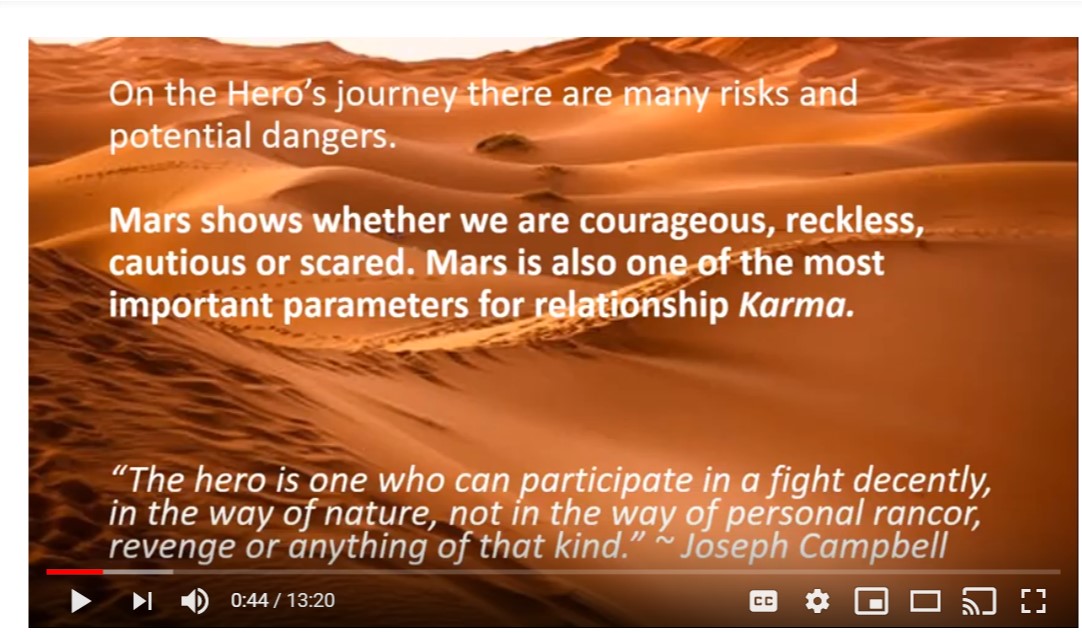
Critical thinking helps us develop rational evaluations of a situation. Mars is not all that useful for critical thinking, he acts first and thinks later. He also has a high threshold of pain - both of traits help the hero spur into action, without them the risks will almost always outweigh the rewards and we will not answer the call of adventure and forge our unique path in life.

In Ayurveda Astrology, Mars shows the health of the adrenal glands and the immune system that fights off enemy pathogens. In Sanskrit Mars is also called Lohit, or red colored. Loha also means iron, so he is also iron bodied, signifying both his protective iron armor, as well is his rulership over the condition and strength of blood iron. If mars is not well disposed he can indicate immune system and blood related disorders.

Mars in our horoscope shows what turns us on, what we are passionate about and where we get all fired up. The word martial in English comes from Mars. Mars has strong physical and mental stamina, but not always the statesmanship required for leadership like the other masculine planet Sun.

Mars is also crucial for spiritual practice as he is the tapas (heat) and discipline required for sustained spiritual practice. The spiritual path requires Mars’s courage and risk taking and one pointed commitment because when Mars make up his mind you cannot negotiate with him. If not well disposed he also risks becoming dogmatic and a fanatic.

Mars gives best results in the action driven houses 3, 6 and 10 and the signs of Gemini, Virgo and Capricorn, that require courage and defeating. While critical thinking may not be Mars’ s best suit, Mars in these houses and signs can be a great at logic, which requires stringing a set of theories or arguments together, so they make sense. A strong Mars here makes great lawyers, engineers, scientists and politicians.
Mars is exalted or fully awake in the earth sign of Capricorn ruled by Saturn. He also thrives in the corresponding tenth house. Under these circumstances his impetuous and thorny nature is tempered by Saturn’s caution and grounded by the earth element. Mars pursuit to win at all cost and Capricorn’s ambition can be a very good mix for success. In other words, Mars’s stamina and Saturn’s perseverance can become a winning formula for achieving at everything from athletics to business success.

Mars is debilitated or asleep in the highly sensitive and emotional moon sign of cancer. Mars’s “Military Mind”, and Moon’s emotions don’t always mix well. Like a good solider he functions best if he does not pause or hesitate and check in with his feelings. Mars is also not the energy you want to bring into the tenderness required by the Moon and zodiac sign of Cancer.

Mars is often described as a double-edged sword. He acts first and thinks about the consequences later because he is oriented to black and white “right and wrong” thinking. Mars’ impatience, anger and frustration is not always directed outwards, it is often directed inwards at ourselves as we use this energy to beat ourselves up and commit acts of rage against our own body and mind. The resulting stress sends cortisol levels rising, depleting our adrenal glands, lowering sex the hormones, and leading to inflammation and auto immune conditions. Prolonged stress raises prolactin levels, increasing the body’s sensitivity to pain, leading to chronic pain disorders.

You can’t really talk about Mars without talking about his influence on interpersonal relationships. He is one of the most important parameters in Vedic Astrologers for difficult relationship karma, just as Venus is for the success of relationships.
Mars causes problems in relationships because his spotlight is on the self as the center of our own universe. Conflict is inevitable in every relationship each and every one of us is designed to uphold our self and to feel good about ourselves, therefore, we all resist situations where our individuality or opinions are questioned or disregarded. To what degree and at what cost we do this will depend on the condition of Mars in our consciousness.
Of course, Mars is also necessary for having the courage to end relationships that are no longer serving us well.
Mismatched sexual drives can also cause conflict in relationships - a strong Mars, especially in houses 7 and 8 is ablaze with sexual intensity and can cause us to lose our heads in sexual passion or feel rejected by our partners relatively lower sex drive.

Certain positions of Mars in the horoscope are considered highly detrimental to relationship karma. This has led to a deep-rooted fear in the Indian culture, especially for women, of having the dreaded planetary "affliction" called Mangal or Kuja (Mars) dosha (flaw), or what is more commonly referred to as Manglik.
People born with Mars in houses 1, 4, 7, 8 or 12 (some also include 2nd house) have the Mars dosha or flaw. One of the solutions astrologers have proposed to this fault in our stars is to marry someone who is also Manglik. Typically, our relationships end up in conflict when one person’s Mars becomes a threat to other person's Mars. For a relationship to work it is crucial that the Mars energies of two people operate in harmony. Therefore, theoretically, there is merit to matching two people who are Manglik, as it balances out assertive pressure on both sides. However, in practice, with both partners under the influence of a headstrong Mars it is easy to see how a relationship can eventually turn into tension, unending arguments, and a war that no one wins.

Considering that the placement of Mars in close to half the houses in the chart is not productive for long term relationships, Manglik seems rather an ineffective parameter, as it will discount 35-40 percent of people on this planet. Even with all the cancellation rules in Vedic Astrology at least a quarter of the population will have this flaw.
Still this ancient concept of mars flaw or Manglik has much to teach us about navigating our intimate relationships, mainly the importance of owning our Mars. In Vedic Astrology, the 7th house of relating and relationships is also the house of our open or known enemies, because our partnership challenge our individuality and self-reliance

According to Hindu custom no marriage is sanctified until the groom ties a very special piece of jewelry around the bride's neck called the Mangal (Mars/auspicious) sutra (string of beads), symbolizing the inseparable bond between the husband and wife. This exclusive and very sacred necklace made of black and gold beads is never worn by unmarried women and very closely guarded by married women, much like the wedding band or ring in the west.
The Mangal sutra necklace is a reminder to both partners (even though it is the woman who wears it) that when we agree to create a union with another person we have to surrender some of our Mars, or our individuality, drive to win, to always be right, and prevail in our point of view.

While, Mars can be detrimental to relationships a good Venus in the horoscope is what the astrologers look for to predict enduring unions. Mars emphasizes the differences, but Venus emphasizes similarities. While Venus is happy to follow someone else's path, Mars has to carve its own unique path in life.
Venus is always ready for negotiation, concession and compromise but mars judges and takes away our ability to see the situation from the partner's perspective. It is Venus that helps us to create the space for our partner to be who they are and not be attached to them for being a certain way. It is so easy to want this kind of unconditional support for ourselves from our partner, but we often forget that they need the same from us.
When we surrender our Mars or military mind we have empathy for our opponent. We risk losing the war and disempowering our individuality. However, we are rewarded by empowering our relationship. Of course, if we are truly meant to carve only our own unique path in life, we are better served to go at it alone, which is the recluse associated side of Mars. Many heroes’ stories have this narrative.
When we surrender our Mars or military mind we have empathy for our opponent. We risk losing the war and disempowering our individuality. However, we are rewarded by empowering our relationship. Of course, if we are truly meant to carve only our own unique path in life, we are better served to go at it alone, which is the recluse associated side of Mars. Many heroes’ stories have this narrative.

So practice being a good loser from time to time and see your relationship thrive and you won't have to worry about being a Manglik or not. (Or use your Mars, take the risk, and get out of a relationship that is not salvageable).
In today’s world most of us no longer have to confront the harsh natural environment of our ancestors. It is unlikely that we will find ourselves face to face with an enemy in a life or death situation, which Mars was designed for. So, we must use our Mars to have the courage to face down our own weaknesses, obsessions, and compulsions and put our ideals into action,
An evolved Mars is a peaceful warrior, he has deeply studied the art of war, his strength is untouchable and his ethics impeccable. One of my favorite hero myth from Joseph Campbell’s collection is the story of the samurai warrior who had the duty to avenge the murder of his overlord. Once he cornered his foe, he was about to kill him with his sword, when the man spat in his face. The samurai walked away. Why? Because he he had become angry, and if he killed the man in this condition, it was a personal act and not the one he was trained for and that he came to do.

It’s not that Mar’s anger and rage are always bad, but the motivation behind them makes all the difference. As Campbells said “Nothing is just a means to an end. Every action is an end in itself. The path is the destination. It’s the journey that matters”.
An evolved Mars is a peaceful warrior, he has deeply studied the art of war, his strength is untouchable and his ethics impeccable. One of my favorite hero myth from Joseph Campbell’s collection is the story of the samurai warrior who had the duty to avenge the murder of his overlord. Once he cornered his foe, he was about to kill him with his sword, when the man spat in his face. The samurai walked away. Why? Because he he had become angry, and if he killed the man in this condition, it was a personal act and not the one he was trained for and that he came to do.
It’s not that Mar’s anger and rage are always bad, but the motivation behind them makes all the difference. As Campbells said “Nothing is just a means to an end. Every action is an end in itself. The path is the destination. It’s the journey that matters”.
Clearly, Mars is a key planet in determining our general leel of happiness and fulfillment in life. Learning to "tune in" to Mars means learning to accomplish desire in smooth and life supporting ways. It also means learning to deal with anger, recognizing it is simply a result of the unfulfilled desires. In this way, reflecting on the placement of Mars in the chart can become a method of spritual development. As the planet of desire, Mars is the root of all attachment in life, and learning to deal with attachment and desires is what life is all about.

